Dental Implants Cost & Insurance Coverage Without Waiting Periods
Last reviewed 2026-11-22 · By Carlos A. Torres Jr., licensed insurance producer · NCD Agent ID #1024251 · Editorial standards
Quick answer
NCD Complete pays for implant services as a Major benefit from your coverage effective date, with no treatment waiting period. It pays 10% of the allowed charge in Year 1, 50% in Year 2 and 60% from Year 3, up to a $3,000 calendar-year implant maximum (inside the $10,000 annual maximum) and 1 per tooth position in 10 calendar years. Implant-supported prosthetics that replace teeth missing before coverage started are excluded.
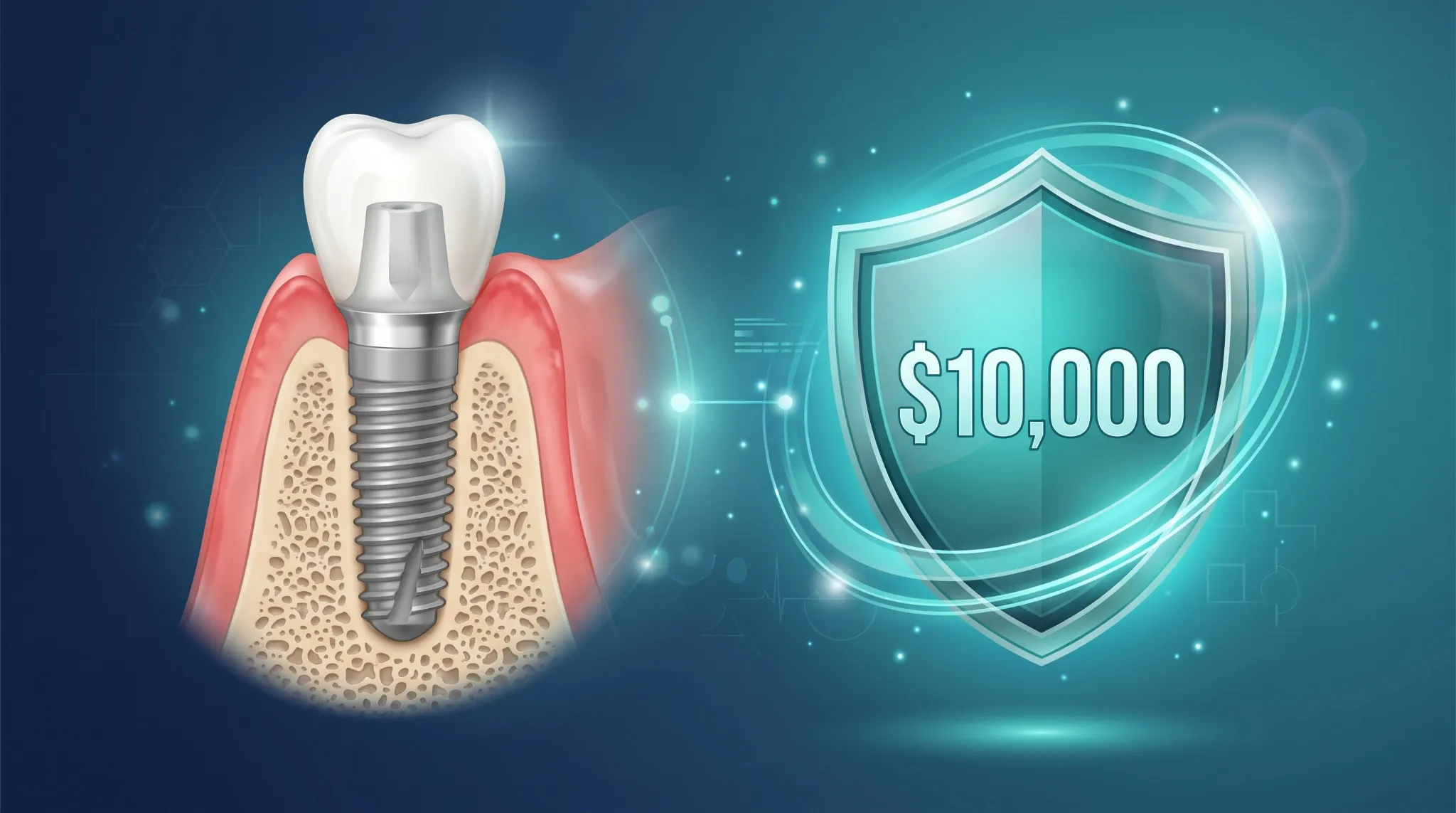
A dentist says you need an implant, and the treatment plan lands on a number that makes you wonder whether insurance will help at all. The honest answer: it can help, but not by as much as the $10,000 headline suggests. Here is exactly what NCD Complete pays, with the math.
What an implant really costs (before insurance)
An implant is billed in pieces. Your dentist’s office may bill the surgical placement of the implant post (D6010), the abutment that connects it (D6057) and the implant-supported crown (D6065). Reported national cash prices, per Gemini’s research record (ADA National Fee Survey and other sources), put a complete single-tooth implant at about $3,500 to $6,000, and an extraction or bone graft first can push the total higher. One published fee list we checked (a multi-state dental chain) totals about $7,150 for the same three pieces, so treat any single range as a starting point and see dental costs for sources and limits. Prices vary by dentist, region and year.
What NCD Complete pays for implants
- No treatment waiting period. Benefits are payable from the start date of your coverage. Services before that date are not covered.
- Major benefit coinsurance. After the $100 lifetime deductible, the plan pays 10% in Year 1, 50% in Year 2 and 60% from Year 3 of the allowed charge.
- A $3,000 implant maximum. Implant services are limited to $3,000 per calendar year. That amount sits inside the $10,000 annual maximum. It does not add to it.
- A frequency limit. One implant service per tooth position in 10 calendar years.
- PPO network pricing. In-network dentists have agreed to accept MetLife’s negotiated fees for covered services, which sets the “allowed charge” the plan uses. Out-of-network dentists are paid on MetLife’s Maximum Allowable Charge, which can be lower than what the dentist bills.
Worked example (hypothetical)
Suppose your dentist’s allowed charge for implant, abutment and crown is $4,500.
| Plan year | Plan pays | You pay |
|---|---|---|
| Year 1 | $440 | $4,060 |
| Year 2 | $2,250 | $2,250 |
| Year 3 and later | $2,700 | $1,800 |
Year 1 assumes the $100 lifetime deductible has not been met; the other years assume it has. In every year the plan’s payment stays under the $3,000 implant maximum in this example.
Now a bigger case: two implants with an allowed charge of $8,000 in Year 3. The plan’s 60% would be $4,800, but the implant maximum stops it at $3,000, so you pay $5,000. That is the sublimit at work.
Hypothetical charges, not quotes. Premiums are not included.
The missing-tooth rule
NCD Complete excludes implant-supported prosthetics that replace teeth missing before you were insured (except congenitally missing teeth). If the tooth has been gone for years, expect this exclusion to matter.
If the tooth is still in your mouth when your coverage starts, a later extraction is not a tooth that was “missing before” coverage on the face of the wording. The certificate of coverage controls, though, so confirm how it applies to you before you count on benefits. For a full walkthrough, see the missing-tooth clause explained.
Five questions to ask about any plan that “covers implants”
- Are implants excluded, or only limited? What is the implant maximum?
- Is there a waiting period for major work?
- What is the overall annual maximum, and who is covered by it?
- What percentage does the plan pay in your first year?
- Is there a missing-tooth clause, and when does it apply?
If you are weighing an implant against a bridge, read implant vs. bridge: cost and coverage. To estimate your own numbers, use the out-of-pocket calculator.
Benefit at a glance (NCD Complete)
| Service | Class | Plan pays | Limit |
|---|---|---|---|
| Implant services | Major (Type C) | 10% / 50% / 60% (Year 1 / 2 / 3+) | 1 per tooth position in 10 calendar years; $3,000 calendar-year implant maximum within the $10,000 plan maximum |
Source: NCD Complete product overview. Percentages apply after the $100 lifetime deductible on Basic and Major services, up to the $10,000 annual maximum. Uninsured cost ranges in this guide are not what the plan pays.
Common questions
Does NCD Complete pay 100% of a dental implant?
No. Implant services are a Major benefit that pays 10% of the allowed charge in Year 1, 50% in Year 2 and 60% from Year 3, after the $100 lifetime deductible, up to a $3,000 calendar-year implant maximum.
Is the $3,000 implant maximum in addition to the $10,000 annual maximum?
No. It is part of the $10,000 maximum, not on top of it.
Is there a waiting period for implants?
NCD's overview lists implant services as payable from the start date of your benefits. Care received before your coverage starts is not covered.
How many implants can I have covered?
One implant service per tooth position in 10 calendar years, and no more than $3,000 of implant benefits in a calendar year.
How much does dental insurance usually pay for implants?
It depends entirely on the plan: some exclude implants, some cap them, and some pay a percentage. Under NCD Complete, implant services pay 10% of the allowed charge in Year 1, 50% in Year 2 and 60% from Year 3, up to $3,000 per calendar year.
How do I get implants covered by insurance?
Before enrolling, check whether the plan covers implants at all, the percentage in your first year, any implant maximum, any missing-tooth exclusion and the effective date. Then ask your dentist for a pre-treatment estimate.
See what NCD Complete would cost you
Your rate depends on your ZIP code and is shown on NCD’s official enrollment site, where you can read the plan terms before you enroll. To find out whether your dentist is in the MetLife PDP Plus network, ask the dentist’s office before treatment.
Marketed in: California, Florida, Michigan, Nevada, Ohio, South Carolina.